
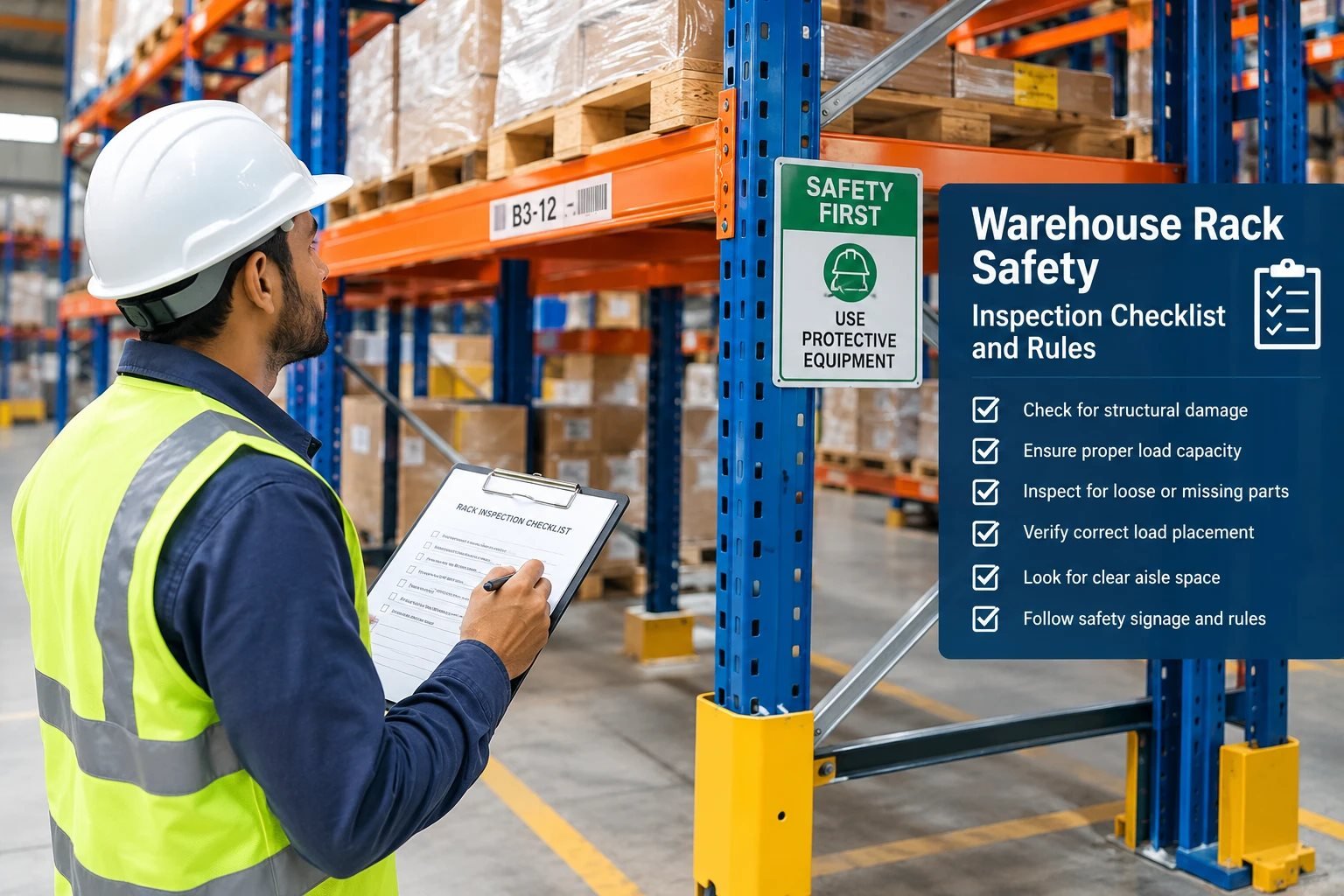
A loaded racking system holds several tonnes of material above the heads of your team. When racks fail, they rarely fail without warning — there is almost always a bent upright, a missing locking pin or an overloaded level that somebody noticed and nobody acted on.
This is a practical safety routine you can start this week, with no special equipment.
1. Display the Load Capacity
Every rack run should carry a load notice showing the safe working load per level and per bay. Without it, nobody on the floor can tell whether a pallet is too heavy — and new staff will assume anything fits.
Remember that rated capacity assumes a uniformly distributed load. A single concentrated weight in the middle of a beam stresses it far more than the same weight spread across the level.
2. Anchor Every Upright
Racks must be anchored to the floor with the right fixings. Anchoring stops the frame shifting when a forklift nudges it, and ties the structure together so a knock to one bay does not topple a run. An unanchored tall rack is the single most common serious fault we see.
3. Protect the Impact Points
Most damage happens in the same three places: aisle ends, column corners near turns, and the bottom 400 mm of uprights where forks swing. Fit column guards and end-of-aisle barriers there. They cost a fraction of a replacement upright and far less than downtime.
4. The Monthly Inspection Checklist
Walk the aisles once a month with this list. It takes 20 minutes for a typical warehouse.
- Uprights — any bend, dent or twist? Look along the column from the floor; a bent column is obvious from that angle.
- Bracing — diagonal and horizontal braces present, straight, and bolted?
- Beams — any visible sag when loaded? Any beam sitting out of its connector?
- Safety pins / locks — every beam should have its locking pin in place. These go missing constantly.
- Base plates and anchors — bolts tight, plates flat on the floor, no cracked concrete.
- Decking — panels or mesh sitting properly, nothing missing or broken.
- Loads — pallets within capacity, placed squarely, nothing overhanging into the aisle.
- Damaged pallets — broken boards transfer load unevenly to the beams.
- Housekeeping — aisles clear, no stock stacked against uprights.
- Lighting — operators must be able to see what they are placing.
Rule for damage: if an upright is visibly bent, unload that bay the same day. Do not wait for the repair to be scheduled.
5. What to Do With Damaged Components
Bent steel does not return to full strength when straightened. A damaged upright or beam should be replaced, not hammered back. Keep a few spare uprights, beams and locking pins in stock — a small inventory means a damaged bay is back in service in hours instead of weeks.
6. Train the People Who Load the Racks
Most damage comes from handling, not from the rack. Simple rules help:
- Approach square to the bay, never at an angle
- Lift to clear the beam before entering; do not drag pallets across beams
- Heaviest loads on the lower levels
- Report every knock, however small — no blame for reporting
That last rule matters most. In warehouses where operators are blamed for accidental knocks, damage stays hidden until it becomes dangerous.
7. Design Decisions That Prevent Problems
Some safety is built in before the first pallet arrives:
- Aisle width matched to the actual truck — tight aisles cause most impacts
- Pallet supports or decking where pallets are damaged or odd-sized
- Correct load rating for the heaviest pallet, with a safety margin
- Separate systems for separate jobs — long material belongs on a cantilever rack, not balanced across pallet beams
Need an Inspection or Replacement Parts?
StackPro Industries supplies replacement uprights, beams, locking pins, column guards and decking for racking systems, and our team can inspect an existing installation and tell you honestly what needs repair, what needs replacement and what is fine.
Send photos of the damaged section on WhatsApp at +91 99716 61873, or contact us here. For planning a new system, see our pallet racking and heavy duty rack pages.